How AI Actually Works (No Math Required)
By Rylee Terry on August 3, 2026
Why artificial intelligence seems more mysterious than it is
Artificial intelligence has quickly become part of everyday life. It powers virtual assistants, recommends movies, helps doctors analyze medical images, translates languages, and even generates text, images, and computer code. Yet despite its growing presence, many people still imagine AI as something mysterious or almost human.
In reality, artificial intelligence is not magic, nor is it conscious. It doesn’t think, feel, or understand the world the way people do. Instead, AI is a collection of computer systems designed to recognize patterns, make predictions, and generate responses based on enormous amounts of data.
You don’t need to understand advanced mathematics to grasp how AI works. The core ideas are surprisingly straightforward once you look beyond the technical jargon.
AI learns from patterns, not from understanding
Imagine teaching a child to recognize dogs. Instead of explaining every biological detail, you might simply show hundreds or thousands of pictures labeled “dog.” Over time, the child begins recognizing common features and can identify dogs they’ve never seen before.
Modern AI learns in a similar way.
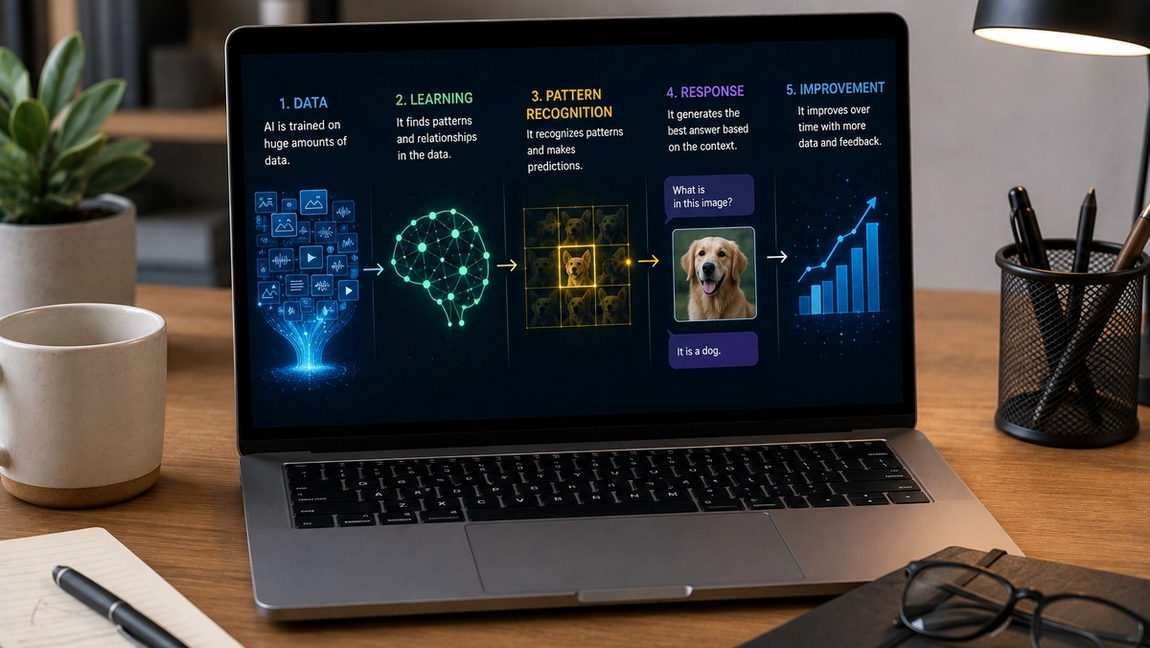
During training, AI systems analyze enormous collections of text, images, audio, or other types of data. Rather than memorizing every example, they learn patterns and relationships that help them make predictions about new information.
For example, an AI trained on millions of sentences begins recognizing how words are commonly used together. It learns grammar, writing styles, facts, and patterns—not because someone manually programmed every rule, but because those patterns repeatedly appear in the training data.
This is why AI can answer questions, summarize articles, translate languages, or generate creative content even though it doesn’t truly “understand” language in the human sense.
Why AI sometimes gets things wrong
Because AI relies on patterns rather than genuine understanding, it can make mistakes.
If the information in its training data is incomplete, outdated, or inconsistent, the AI may produce incorrect or misleading responses. It can also confidently generate information that sounds believable but is actually inaccurate—a phenomenon often called a “hallucination.”
Unlike humans, AI has no personal experiences, intuition, or common sense. It cannot independently verify whether a statement is true unless it has access to reliable information during the interaction.
The quality of an AI’s response also depends heavily on the question it receives. Clear, detailed prompts usually produce better results than vague or ambiguous instructions because they provide stronger context for the model to follow.
This is why AI works best as a tool that assists human decision-making rather than replacing human judgment entirely.
How AI generates responses
When you ask an AI a question, it doesn’t search through a hidden database containing ready-made answers.
Instead, it predicts what information or words are most likely to come next based on the patterns it learned during training and the context of your conversation.
Think of it as an incredibly advanced autocomplete system. Your smartphone predicts the next word in a text message using recent context. AI performs a similar task, but on a vastly larger scale, using billions of learned relationships between words, ideas, images, and concepts.
Every sentence is generated one piece at a time. As each word is produced, the AI considers everything that came before it and predicts what should come next.
Although this process happens almost instantly, it allows AI to produce conversations, stories, explanations, computer code, translations, and many other forms of content.
AI is a powerful tool, not a replacement for people
Artificial intelligence is transforming industries by helping people work faster, automate repetitive tasks, and analyze information more efficiently. Businesses use AI to improve customer service, detect fraud, forecast demand, and support decision-making. Healthcare professionals use it to assist with diagnosis and medical research. Educators, designers, writers, and software developers increasingly use AI to enhance creativity and productivity.
However, AI still depends on human oversight.
People define the goals, provide the training data, evaluate results, and decide how AI should be used responsibly. Critical thinking, ethical judgment, creativity, empathy, and complex decision-making remain uniquely human strengths that AI cannot fully replicate.
Ultimately, artificial intelligence is best understood as a sophisticated prediction system rather than a machine that truly thinks. It learns from patterns in enormous amounts of data, generates responses based on probability, and continuously improves through better models and information. Once you understand that AI is designed to recognize patterns—not to possess human consciousness—the technology becomes far less mysterious and much easier to appreciate for what it really is: one of the most powerful tools humans have ever created.