The Real Difference Between AI, Machine Learning, and Deep Learning
By Lena Moyer on August 3, 2026
Why these terms are often confused
Artificial intelligence has become one of the most talked-about technologies in the world, yet many people use the terms artificial intelligence (AI), machine learning (ML), and deep learning (DL) as if they all mean the same thing. While they are closely related, they describe different concepts.
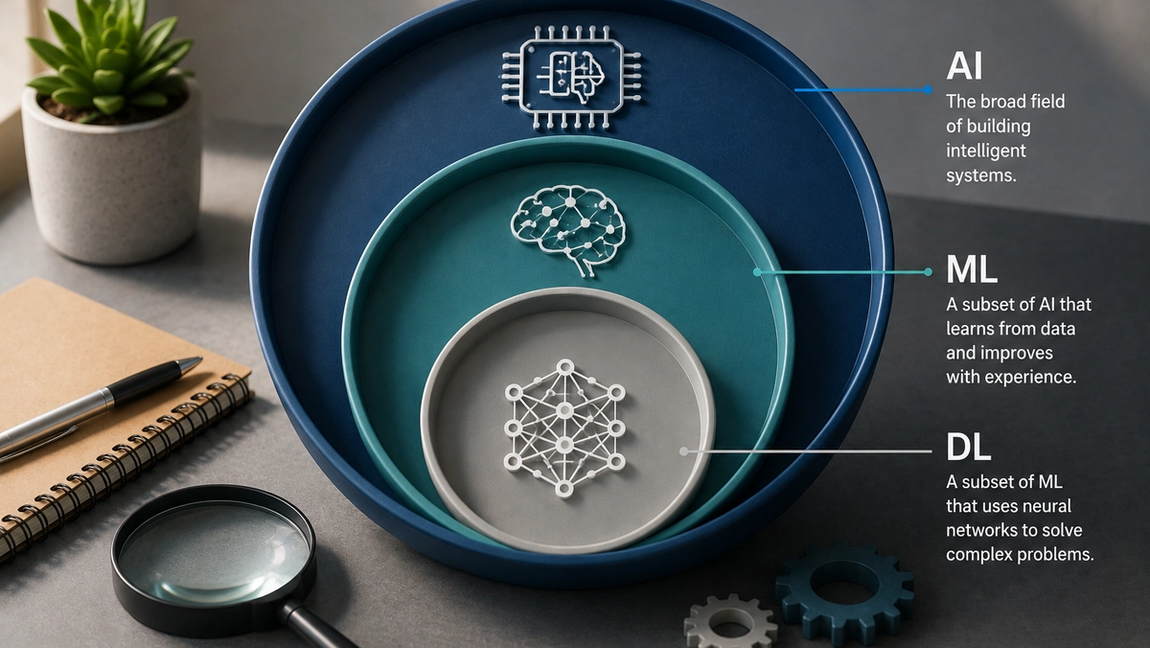
Think of them as nested layers. Artificial intelligence is the broadest category. Machine learning is one approach used to build AI systems. Deep learning is a specialized type of machine learning designed to solve more complex problems using large amounts of data.
Understanding the difference doesn’t require a background in computer science. Once you see how these technologies relate to one another, the terminology becomes much easier to understand.
Artificial intelligence is the big picture
Artificial intelligence refers to the broader goal of creating computer systems that can perform tasks normally requiring human intelligence.
These tasks include recognizing speech, understanding language, making decisions, solving problems, translating text, identifying objects in images, and generating creative content.
Importantly, not every AI system learns from experience. Some AI applications rely on predefined rules written by programmers. For example, a simple chess program that follows fixed strategies or a customer support chatbot with scripted responses can both be considered forms of artificial intelligence.
In other words, AI is the overall field focused on making computers behave intelligently, regardless of the specific technology used.
Machine learning teaches computers through data
Machine learning is a subset of artificial intelligence that allows computers to improve their performance by learning from data instead of relying entirely on manually programmed rules.
Rather than telling a computer every possible scenario it might encounter, developers provide examples. The system identifies patterns within those examples and uses them to make predictions about new situations.
For instance, an email spam filter can analyze thousands of emails labeled as “spam” or “not spam.” Over time, it learns the characteristics of unwanted messages and becomes increasingly accurate at filtering future emails.
Recommendation systems used by streaming platforms and online retailers also rely heavily on machine learning. By analyzing user behavior, they predict which movies, songs, or products someone is most likely to enjoy.
Machine learning works well when enough high-quality data is available and the patterns can be learned from previous examples.
Deep learning handles the most complex tasks
Deep learning is a specialized branch of machine learning that uses artificial neural networks inspired by the structure of the human brain.
While the inspiration comes from neuroscience, these networks are mathematical models—not actual brains. Their strength lies in their ability to process enormous amounts of information and automatically identify highly complex patterns.
Deep learning has enabled many of the most impressive AI breakthroughs in recent years. It powers technologies such as facial recognition, speech recognition, language translation, autonomous vehicles, image generation, and modern AI assistants.
Unlike traditional machine learning, which often requires humans to identify the most important characteristics in a dataset, deep learning can automatically discover many of those patterns on its own.
The trade-off is that deep learning typically requires much larger datasets, significantly more computing power, and longer training times than simpler machine learning methods.
How they work together
The easiest way to understand these technologies is to think of them as a hierarchy.
Artificial intelligence is the broad field that includes every attempt to create intelligent computer systems. Machine learning is one of the most successful techniques used to achieve that goal by allowing computers to learn from data. Deep learning is an advanced form of machine learning that excels at solving highly complex problems using large neural networks.
Not every AI application uses machine learning, and not every machine learning model uses deep learning. The appropriate approach depends on the problem being solved.
Simple tasks with clear rules may not require machine learning at all. Predictive analytics, recommendation systems, and fraud detection often use traditional machine learning. More advanced applications involving images, speech, language, and complex pattern recognition frequently rely on deep learning.
Ultimately, AI, machine learning, and deep learning are not competing technologies—they are complementary. Artificial intelligence defines the overall ambition of building intelligent systems, machine learning provides a practical way for those systems to learn from data, and deep learning extends those capabilities to tackle some of the world’s most sophisticated computational challenges. Understanding how these concepts fit together makes it much easier to follow the rapidly evolving world of artificial intelligence and appreciate the technology shaping modern life.