The Real Difference Between Seed, Series A, and Series B
By Lena Moyer on August 3, 2026
Why funding rounds exist
If you’ve ever read about startups, you’ve probably seen headlines announcing that a company has raised a “Seed Round,” “Series A,” or “Series B.” While these terms are common in the startup world, they often create confusion for new entrepreneurs.
Many people assume these funding rounds simply represent increasingly larger investments. While the amount of capital usually grows, the real difference lies in what the business is expected to achieve at each stage.
Every funding round has a purpose. Investors provide capital because they believe the startup has reached a certain milestone and is ready to accomplish the next one. Understanding these stages helps founders know when to seek investment, what investors expect, and how their business should evolve over time.
Seed funding: proving the idea can work
Seed funding is usually the first significant investment a startup receives after bootstrapping or support from friends and family.
At this stage, the company is still validating its business model. The founders have identified a problem, developed an initial solution, and are working to prove that customers actually want it. Revenue may be limited, and the product is often still being refined based on user feedback.
Seed funding is commonly provided by angel investors, startup accelerators, early-stage venture capital firms, or dedicated seed funds.
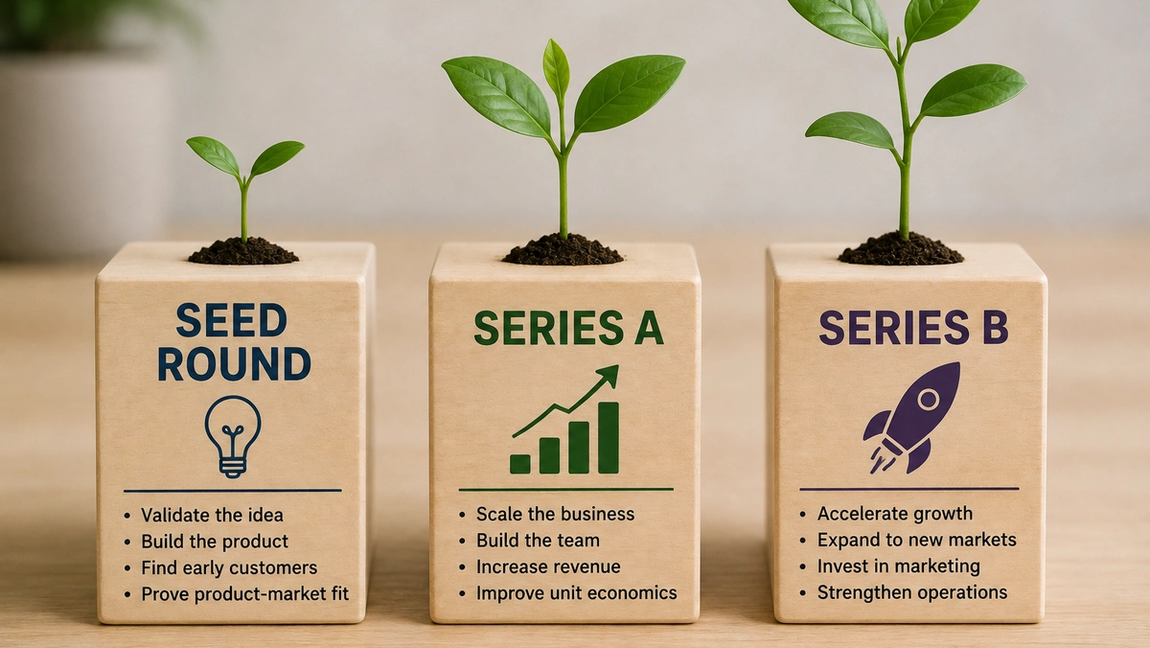
The primary objective of a seed round is not rapid expansion. Instead, the funding helps the company build a stronger product, hire its first employees, attract early customers, and demonstrate product-market fit—the point where customers consistently value and purchase the solution.
Investors at this stage understand that risk is high. They are often investing in the founding team, the size of the market opportunity, and the startup’s potential more than its current financial performance.
Series A: building a scalable business
A startup typically seeks Series A funding once it has demonstrated that its business model works and shows evidence of consistent growth.
By this point, the company usually has an established product, paying customers, measurable revenue, and data that supports future expansion. Instead of asking, “Does anyone want this product?” the focus becomes, “How can we grow efficiently?”
Series A funding is commonly used to expand the team, improve technology, strengthen marketing, invest in sales, and scale operations.
Investors now expect more than a compelling idea. They want to see clear performance metrics, such as customer acquisition costs, retention rates, recurring revenue, profit margins, or other indicators showing that growth can continue.
Because larger amounts of capital are involved, the fundraising process also becomes more rigorous. Venture capital firms conduct extensive due diligence, reviewing financial records, legal documentation, market analysis, and long-term business strategy before making an investment.
Series A is often considered the transition from an early startup to a company with the potential to become a major business.
Series B: accelerating growth
By the time a startup reaches Series B, the business has typically proven that customers value its product and that the company can grow successfully.
The challenge is no longer proving the concept—it is expanding as quickly and efficiently as possible.
Series B funding often supports entering new geographic markets, hiring larger teams, developing additional products, investing heavily in marketing, strengthening infrastructure, or pursuing strategic acquisitions.
At this stage, investors expect substantial evidence of traction. Revenue growth is usually well established, operational processes are more mature, and leadership teams have expanded beyond the original founders.
Competition also becomes increasingly important. Companies raising Series B funding often operate in fast-moving industries where scaling quickly can determine long-term market leadership.
While investors continue evaluating future potential, they place greater emphasis on execution, operational efficiency, and the startup’s ability to become a dominant player in its industry.
Every round prepares the business for the next stage
Although funding amounts generally increase from Seed to Series A and Series B, the purpose of each round remains the same: helping the company reach its next milestone.
Seed funding helps prove the idea. Series A focuses on building a repeatable and scalable business model. Series B provides the resources needed to expand rapidly and strengthen the company’s market position.
It’s important to remember that not every startup follows this exact path. Some businesses raise only a seed round before becoming profitable. Others continue through Series C, Series D, and beyond as they pursue international expansion or prepare for an initial public offering (IPO). Many successful companies also rely primarily on customer revenue rather than outside investment.
Ultimately, fundraising is not a measure of success in itself. Each investment round is simply a tool that provides the resources needed to achieve sustainable growth. The strongest startups raise capital only when it helps them create more value for customers, strengthen their business model, and move confidently toward their long-term vision.