The Real Reason Most Startups Fail in Year One
By Bailey Walls on August 3, 2026
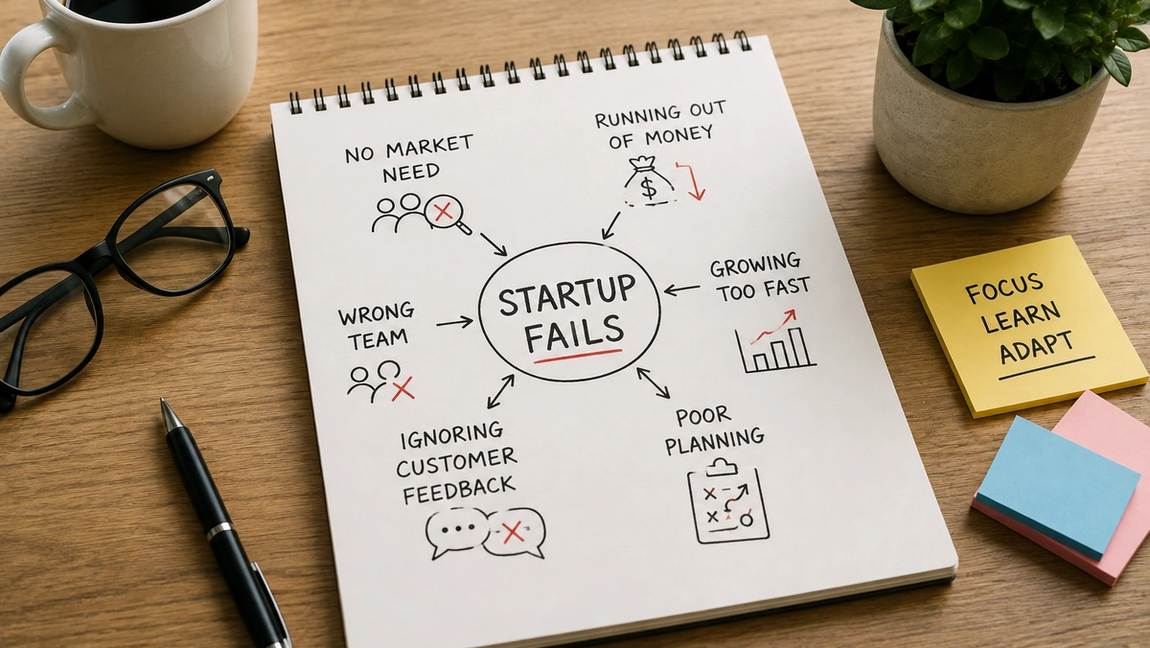
Why failure is more common than success
Every year, thousands of startups are launched with ambitious goals, innovative ideas, and passionate founders. Yet many of them never make it past their first year. While it’s easy to blame bad luck, a weak economy, or intense competition, the reality is often much simpler.
Most startups don’t fail because the founders lacked motivation or worked too little. They fail because they build businesses based on assumptions instead of evidence. They create products before understanding their customers, spend money before generating revenue, or try to grow before establishing a sustainable foundation.
The first year of a startup is less about moving fast and more about learning quickly. The businesses that survive are usually the ones that adapt faster than the market changes around them.
Building something nobody wants
One of the most common reasons startups fail is the absence of real market demand.
Founders often become emotionally attached to an idea and invest months developing a product without first confirming that customers actually need it. By the time they launch, they discover that the problem isn’t significant enough or that existing alternatives already satisfy the market.
Successful startups begin by understanding the customer, not the product. They conduct interviews, gather feedback, test prototypes, and validate demand before making significant investments.
The goal is not to prove the idea is brilliant—it is to prove that customers are willing to spend time, attention, or money on the solution.
Without product-market fit, even an exceptional product can struggle to survive.
Running out of money before gaining traction
Cash flow is another major reason startups fail during their first year.
Many founders underestimate how long it takes to acquire customers and overestimate how quickly revenue will grow. At the same time, expenses continue to accumulate through salaries, marketing, software, office space, manufacturing, or product development.
This imbalance can quickly drain available funds.
Managing cash carefully is often more important than raising large amounts of investment. Founders should understand exactly how much money they have, how quickly they are spending it, and how long they can continue operating before additional funding or revenue becomes necessary.
A startup doesn’t necessarily fail because it isn’t profitable immediately. It fails when it runs out of resources before reaching the next stage of growth.
Trying to grow too fast
Growth is exciting, but growing before the business is ready can create serious problems.
Some startups invest heavily in advertising, hire large teams, or expand into multiple markets before they have established a repeatable business model. While rapid growth may generate impressive numbers initially, it often magnifies underlying weaknesses.
If customer retention is poor, increasing marketing simply attracts more customers who eventually leave. If operational processes are inefficient, hiring more employees may increase complexity without improving performance.
Healthy growth is built on strong foundations. Businesses should first demonstrate that they can consistently attract customers, deliver value, and operate efficiently before investing heavily in expansion.
Scaling a broken system rarely fixes it—it usually makes the problems larger.
Learning, adapting, and staying resilient
No startup begins with all the answers. Every successful company experiences setbacks, unexpected challenges, and moments of uncertainty.
What separates businesses that survive from those that fail is their ability to learn. Founders who listen to customers, measure results, adapt their strategies, and make informed decisions are far more likely to overcome early obstacles.
Resilience also means knowing when to change direction. Sometimes a small adjustment to pricing, target audience, marketing strategy, or product features is enough to unlock growth. In other cases, a complete pivot may be necessary. The willingness to evolve is often one of the greatest strengths a startup can possess.
Ultimately, most startups don’t fail because the founders weren’t talented or hardworking. They fail because they spend too much time building and too little time validating, listening, and adapting. The first year is not a test of perfection—it’s a test of learning. Entrepreneurs who stay close to their customers, manage their resources wisely, and remain flexible in the face of change give themselves the best chance of turning a promising idea into a lasting business.