The Difference Between Narrow AI and General AI
By Knox Vincent on August 3, 2026
Why not all AI is the same
Artificial intelligence is often portrayed in movies as machines that think, reason, and behave just like humans. In reality, today’s AI is far more specialized. While it can perform remarkable tasks—from generating text and recognizing images to driving recommendations on streaming platforms—it is designed to solve specific problems rather than possess broad human intelligence.
This distinction explains why experts often separate artificial intelligence into two categories: Narrow AI and General AI. Understanding the difference helps clarify what current AI systems can actually do, what they cannot do, and why discussions about the future of AI often focus on capabilities that do not yet exist.
Although both fall under the umbrella of artificial intelligence, they represent very different levels of ability.
Narrow AI: the technology we use today
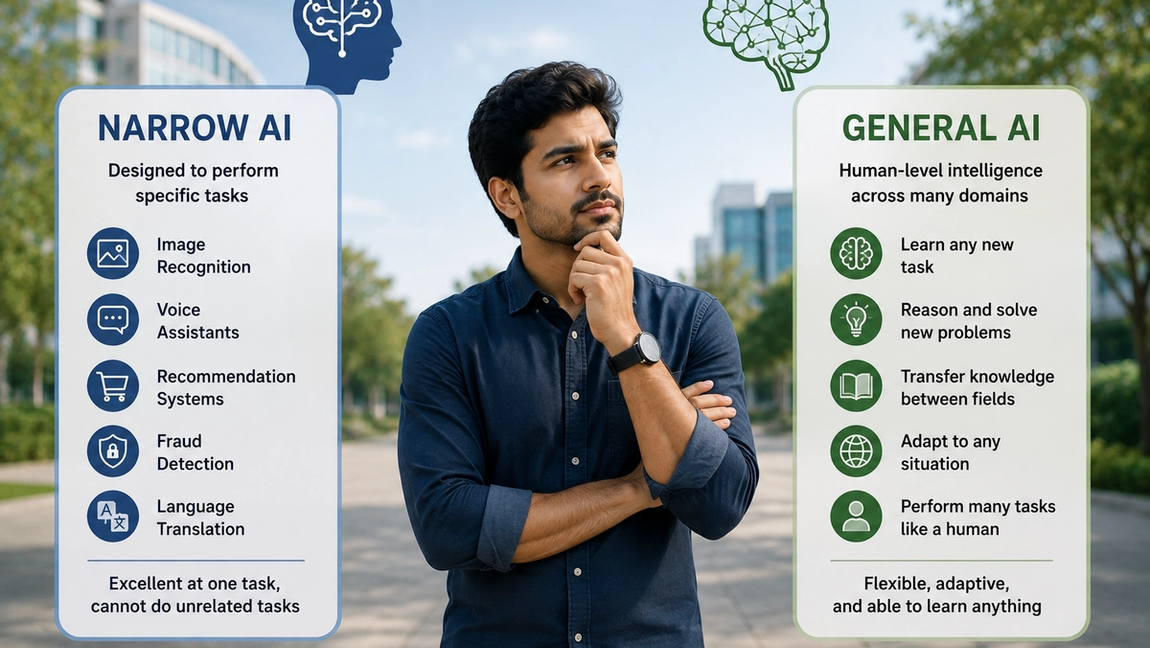
Narrow AI, sometimes called Weak AI, refers to systems designed to perform specific tasks.
Every AI application currently used by businesses and consumers falls into this category. Virtual assistants answer questions, recommendation systems suggest movies, navigation apps calculate routes, fraud detection software identifies suspicious transactions, and language models generate text. Each system is highly capable within its own area but cannot perform unrelated tasks without being specifically designed or trained to do so.
For example, an AI that excels at recognizing medical images cannot suddenly manage a company’s finances or compose music. Likewise, an AI chatbot that writes articles cannot independently learn to operate industrial machinery without additional training and development.
Narrow AI appears intelligent because it performs specialized tasks extremely well, but it does not possess human-like reasoning across a wide range of activities.
General AI: the idea of human-level intelligence
General AI, often called Artificial General Intelligence (AGI), describes a hypothetical system capable of performing intellectual tasks across many different domains at a level comparable to—or potentially beyond—that of humans.
Unlike Narrow AI, General AI would not need to be built separately for each new task. It could learn unfamiliar skills, transfer knowledge between different fields, reason through new situations, and solve problems it had never encountered before.
For instance, a General AI might analyze financial data in the morning, write a legal brief in the afternoon, learn a new programming language in the evening, and then help design a scientific experiment—all without requiring entirely separate systems for each activity.
This flexibility is one of the defining characteristics of human intelligence. People naturally apply knowledge from one area to another, adapt to unfamiliar situations, and continue learning throughout their lives.
At present, however, General AI remains a research goal rather than an existing technology.
Why today’s AI isn’t General AI
Modern AI systems have achieved extraordinary performance in many specialized tasks, leading some people to believe that General AI already exists.
The reality is more nuanced.
Today’s AI models can appear highly versatile because they are trained on vast amounts of diverse information. They can answer questions, generate code, summarize documents, translate languages, and assist with creative work within a single interface.
However, these capabilities are still forms of Narrow AI. They are based on pattern recognition learned during training rather than genuine understanding, self-awareness, or independent reasoning across every possible situation.
Current AI systems also require significant human guidance. They can make mistakes, misunderstand context, struggle with unfamiliar situations, and rely on people to define goals, evaluate outputs, and make important decisions.
Being impressive at many tasks is not the same as possessing general intelligence.
The future of artificial intelligence
Researchers continue exploring ways to make AI systems more adaptable, efficient, and capable of learning across different domains. Progress in reasoning, memory, planning, robotics, and multimodal learning is steadily expanding what AI can accomplish.
Whether true General AI will eventually be achieved remains one of the biggest questions in technology. Some experts believe it could emerge within decades, while others argue that human-level intelligence requires abilities that current approaches cannot yet replicate.
Regardless of when—or if—General AI arrives, Narrow AI is already transforming industries around the world. Businesses use it to automate routine tasks, healthcare providers use it to assist with diagnosis, educators use it to personalize learning, and researchers rely on it to accelerate scientific discovery.
Ultimately, the difference between Narrow AI and General AI comes down to scope. Narrow AI excels at specific tasks and powers virtually every AI application available today. General AI represents the vision of a system capable of learning, reasoning, and adapting across virtually any intellectual challenge, much like a human being. Understanding this distinction helps separate today’s technological reality from tomorrow’s possibilities while appreciating just how far artificial intelligence has already come.