The Difference Between SaaS, PaaS, and IaaS
By Knox Vincent on August 3, 2026
Why these cloud terms matter
As businesses increasingly move their operations to the cloud, terms like Software as a Service (SaaS), Platform as a Service (PaaS), and Infrastructure as a Service (IaaS) have become common in conversations about technology. While they may sound similar, each represents a different way of delivering computing resources over the internet.
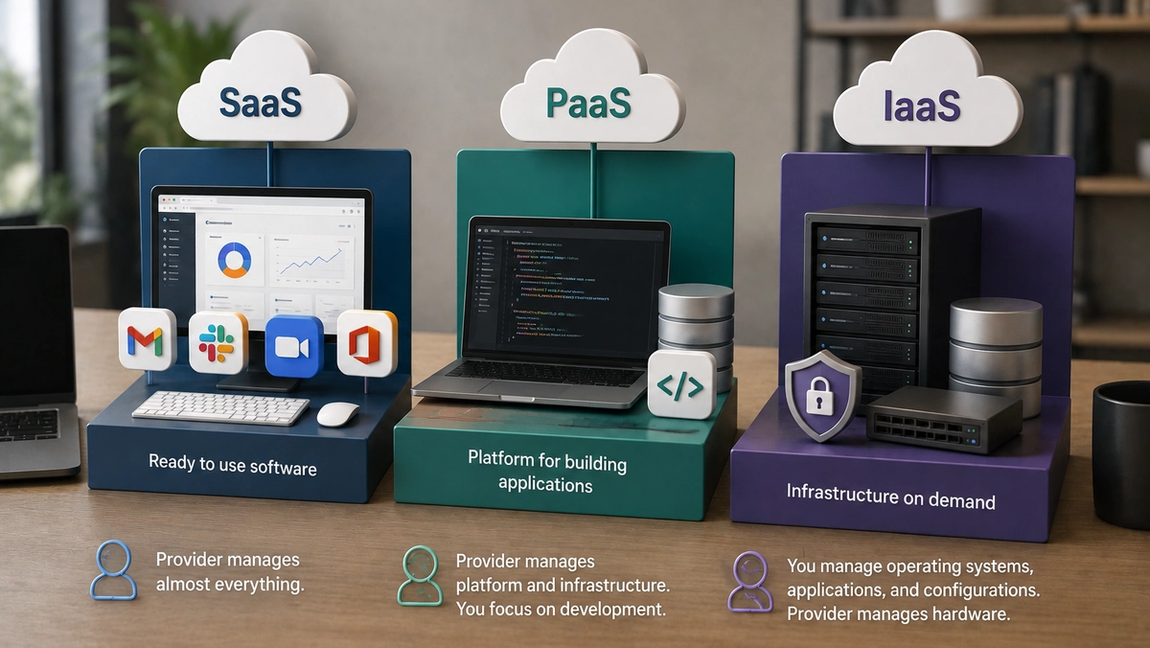
The easiest way to understand them is to think about responsibility. The more responsibility the cloud provider takes on, the less the customer has to manage. SaaS offers fully managed software, PaaS provides a platform for building applications, and IaaS delivers the underlying computing infrastructure while leaving more control in the hands of the customer.
Choosing the right model depends on what an organization wants to achieve, how much technical expertise it has, and how much control it needs over its technology environment.
SaaS: software that’s ready to use
Software as a Service (SaaS) is the cloud model most people use every day, often without realizing it.
Instead of purchasing software and installing it on individual computers, users access applications through a web browser or mobile app. The cloud provider manages the servers, software updates, security, maintenance, and infrastructure behind the scenes.
Common examples include email platforms, video conferencing tools, customer relationship management (CRM) systems, accounting software, and online collaboration platforms.
For businesses, SaaS offers several advantages. It reduces upfront costs, eliminates the need for maintaining complex infrastructure, and allows employees to work from almost anywhere with an internet connection.
The trade-off is that users typically have limited control over how the software itself is configured beyond the options provided by the vendor. Organizations rely on the provider for updates, new features, and system availability.
PaaS: a platform for building applications
Platform as a Service (PaaS) is designed primarily for software developers.
Instead of managing physical servers, operating systems, databases, and networking infrastructure, developers receive a complete environment where they can build, test, and deploy applications more efficiently.
The cloud provider manages much of the underlying infrastructure, allowing development teams to focus on writing code rather than maintaining servers.
This significantly speeds up software development and reduces operational complexity.
PaaS is particularly useful for organizations creating custom applications because it provides built-in development tools, databases, security features, and deployment services without requiring teams to manage every technical detail themselves.
However, because developers work within the provider’s platform, they may have less flexibility than they would with full infrastructure control.
IaaS: complete control over infrastructure
Infrastructure as a Service (IaaS) provides the fundamental building blocks of cloud computing.
Instead of buying physical servers, storage devices, and networking equipment, organizations rent virtual infrastructure from a cloud provider. Customers decide which operating systems to install, which applications to run, and how to configure their environments.
The provider maintains the physical hardware, while the customer manages the operating systems, security configurations, applications, and much of the software stack.
This model offers the greatest flexibility and control.
Businesses often choose IaaS when migrating existing systems to the cloud, supporting complex enterprise applications, or running workloads that require customized infrastructure.
The additional flexibility comes with greater responsibility. Organizations must have the technical expertise needed to configure, maintain, monitor, and secure their cloud environments effectively.
Choosing the right cloud model
SaaS, PaaS, and IaaS are not competing technologies—they address different business needs.
Companies that simply want to use business software with minimal technical management often choose SaaS. Organizations developing their own applications frequently benefit from PaaS because it simplifies software development. Businesses requiring maximum flexibility and control over their computing environments often select IaaS.
Many organizations use all three simultaneously.
For example, a company may rely on SaaS for email and collaboration, use PaaS to develop customer-facing applications, and operate critical business systems on IaaS infrastructure.
Ultimately, the difference comes down to how much of the technology stack you want to manage yourself. SaaS delivers ready-to-use software, PaaS provides the tools and environment needed to build applications, and IaaS supplies the underlying computing infrastructure. Together, these cloud service models have transformed how businesses deploy technology, enabling organizations of every size to innovate faster, scale more efficiently, and reduce the cost of managing complex IT systems.