How Cybersecurity Actually Protects a Business
By Bailey Walls on August 3, 2026
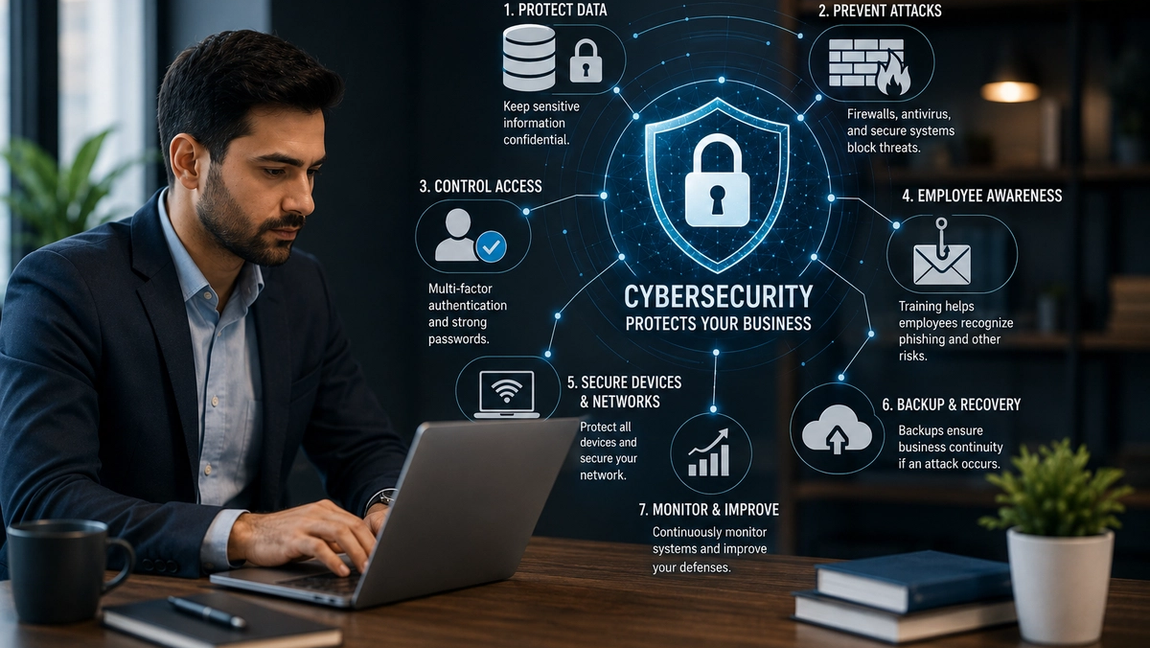
Why cybersecurity is everyone’s responsibility
Cybersecurity is often associated with firewalls, antivirus software, and IT departments working behind the scenes. While these technologies are important, modern cybersecurity is much broader than simply installing security software.
Every business—whether it’s a startup, a small local company, or a multinational corporation—stores valuable information. Customer records, financial data, employee information, intellectual property, contracts, and business operations all rely on digital systems. Protecting these assets has become essential because cyber threats continue to grow in both frequency and sophistication.
Cybersecurity is not just about preventing attacks. It is about ensuring that a business can continue operating safely, protect customer trust, and recover quickly if an incident occurs.
Understanding what businesses are protecting
A successful cyberattack rarely targets technology alone. The real objective is usually the valuable information stored within business systems.
Hackers may attempt to steal customer data, gain access to financial accounts, lock company files using ransomware, disrupt operations, or exploit confidential business information for financial gain.
Employees are often targeted as well. Phishing emails, fraudulent websites, and fake login pages are designed to trick people into revealing passwords or downloading malicious software.
For this reason, cybersecurity focuses on protecting three essential elements, often referred to as the CIA Triad:
- Confidentiality, ensuring sensitive information is accessible only to authorized individuals.
- Integrity, protecting data from unauthorized changes or tampering.
- Availability, ensuring systems and information remain accessible when employees and customers need them.
A strong cybersecurity strategy aims to maintain all three simultaneously.
Building multiple layers of defense
One of the biggest misconceptions about cybersecurity is that a single tool can solve every security problem.
In reality, businesses rely on multiple layers of protection.
Firewalls help monitor and filter network traffic. Antivirus and endpoint security software detect malicious programs. Multi-factor authentication adds an extra verification step beyond passwords. Encryption protects sensitive information while it is stored or transmitted. Regular software updates close known security vulnerabilities before attackers can exploit them.
Equally important are secure backups. If ransomware encrypts business files, reliable offline or cloud backups allow organizations to restore critical information without paying criminals.
No individual security measure is perfect, but together these layers significantly reduce risk and make successful attacks far more difficult.
People are just as important as technology
Many cybersecurity incidents begin with human error rather than technical failures.
An employee may click on a phishing email, reuse a weak password, accidentally share confidential information, or connect an unsecured device to the company network.
This is why employee awareness has become one of the most important aspects of cybersecurity.
Regular security training helps staff recognize suspicious emails, create strong passwords, protect sensitive information, and report unusual activity before small mistakes become major incidents.
Businesses also benefit from clearly defined security policies, access controls, and procedures that ensure employees only have access to the systems and information required for their roles.
Technology provides protection, but informed employees strengthen every layer of security.
Cybersecurity is an ongoing process
There is no point at which a business becomes completely secure.
Cyber threats evolve constantly, and attackers continuously develop new techniques to exploit software vulnerabilities, human behavior, and emerging technologies. As a result, cybersecurity requires continuous monitoring, regular risk assessments, software updates, and periodic testing of security controls.
Organizations should also prepare for the possibility of an incident. An effective incident response plan outlines how to identify attacks, contain damage, restore operations, communicate with customers, and learn from the event to improve future resilience.
Businesses that prepare in advance often recover far more quickly than those responding without a plan.
Ultimately, cybersecurity is about protecting more than computers—it safeguards the information, operations, reputation, and trust that businesses depend on every day. By combining strong technology, well-trained employees, thoughtful policies, and ongoing vigilance, organizations can significantly reduce cyber risk while building the resilience needed to operate confidently in an increasingly digital world.