How Encryption Keeps Your Data Safe
By Lena Moyer on August 3, 2026
Why encryption matters more than ever
Every day, we send messages, make online payments, store photos in the cloud, and access personal accounts from multiple devices. Behind each of these activities is an invisible technology that helps keep our information private: encryption.
Although the word may sound highly technical, encryption is simply a way of protecting data by making it unreadable to anyone who isn’t authorized to see it. Without encryption, sensitive information such as passwords, credit card numbers, medical records, and private conversations could be far more vulnerable to theft or misuse.
As more of our personal and professional lives move online, encryption has become one of the most important foundations of digital security.
Turning readable information into secret code
At its core, encryption transforms ordinary information into coded data.
Imagine writing a message in a secret language that only you and your friend understand. If someone else intercepts the message, they would see meaningless symbols instead of the original text.
Modern encryption works in a similar way, but instead of using simple substitution ciphers, it relies on sophisticated mathematical algorithms and digital keys.
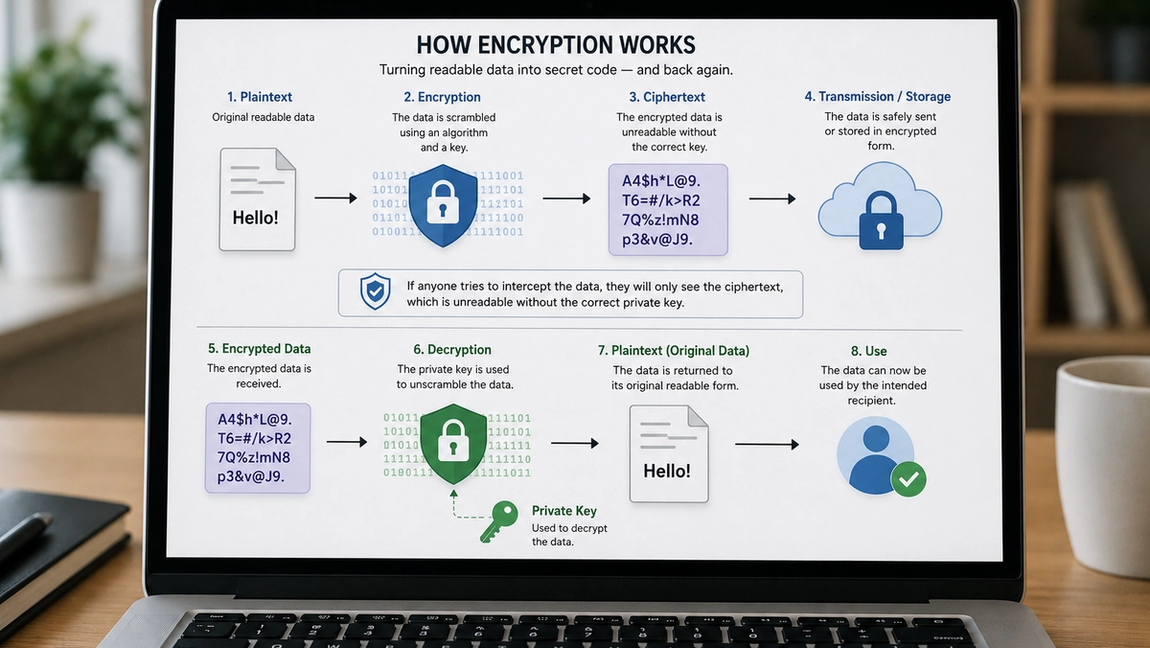
When information is encrypted, the original readable content—known as plaintext—is converted into an unreadable form called ciphertext. Only someone with the correct digital key can reverse the process and restore the original information through decryption.
Without the proper key, the encrypted data appears as random characters and is practically impossible to interpret using today’s computing technology.
How encryption protects everyday activities
Encryption is working behind the scenes far more often than most people realize.
When you log into your online banking account, encryption helps protect your password as it travels across the internet. When you send a message through secure messaging apps, encryption prevents unauthorized people from reading the conversation while it is being transmitted. When you shop online, encryption helps safeguard your payment information before it reaches the retailer.
Even many smartphones and laptops automatically encrypt the data stored on the device. If the device is lost or stolen, encryption makes it much harder for someone else to access personal files without the correct password or authentication method.
Cloud storage providers also use encryption to protect files while they are stored on their servers and while they are being transferred between devices.
In many cases, people benefit from encryption every day without even realizing it.
Two common types of encryption
Most modern encryption relies on two complementary approaches.
Symmetric encryption uses the same key to encrypt and decrypt information. Because only one key is involved, this method is extremely fast and is commonly used to protect stored files, databases, and other large amounts of data.
Asymmetric encryption, also known as public-key encryption, uses two different keys: a public key that anyone can use to encrypt information and a private key that only the intended recipient possesses to decrypt it.
This system makes secure communication possible even between people who have never met before. It is widely used for secure websites, digital signatures, email security, and online banking.
In practice, many online services combine both methods to achieve high levels of security while maintaining fast performance.
Encryption is powerful—but not perfect
Encryption is one of the strongest tools available for protecting digital information, but it is not a complete cybersecurity solution on its own.
If someone gains access to your passwords through phishing, malware, or weak security practices, encryption cannot always prevent unauthorized access because the attacker may already possess the necessary credentials.
This is why strong passwords, multi-factor authentication, software updates, and safe online habits remain essential components of digital security.
Encryption protects information while it is stored and transmitted, but users still play a critical role in keeping their accounts and devices secure.
Ultimately, encryption works by transforming readable information into coded data that only authorized parties can unlock using the correct digital keys. It quietly protects billions of online interactions every day, from banking transactions and private messages to cloud storage and business communications. While most people rarely notice it working in the background, encryption has become one of the most important technologies enabling trust, privacy, and security in the digital world. Without it, many of the online services we rely on every day simply could not operate safely.