How Large Language Models Like ChatGPT Generate Text
By Skye Castro on August 3, 2026
Why AI can sound surprisingly human
From answering questions and writing emails to generating code and translating languages, large language models (LLMs) have transformed how people interact with technology. Their responses often feel so natural that it’s easy to assume they truly understand language or think like humans.
The reality is different. Large language models do not think, reason, or experience the world the way people do. They do not have beliefs, emotions, or consciousness. Instead, they generate text by identifying patterns in language learned from vast amounts of written material.
Understanding how this process works doesn’t require a degree in computer science. Once you understand the basic idea, the technology becomes much less mysterious.
It all starts with learning patterns
Before a large language model can answer questions or write articles, it must go through a training process.
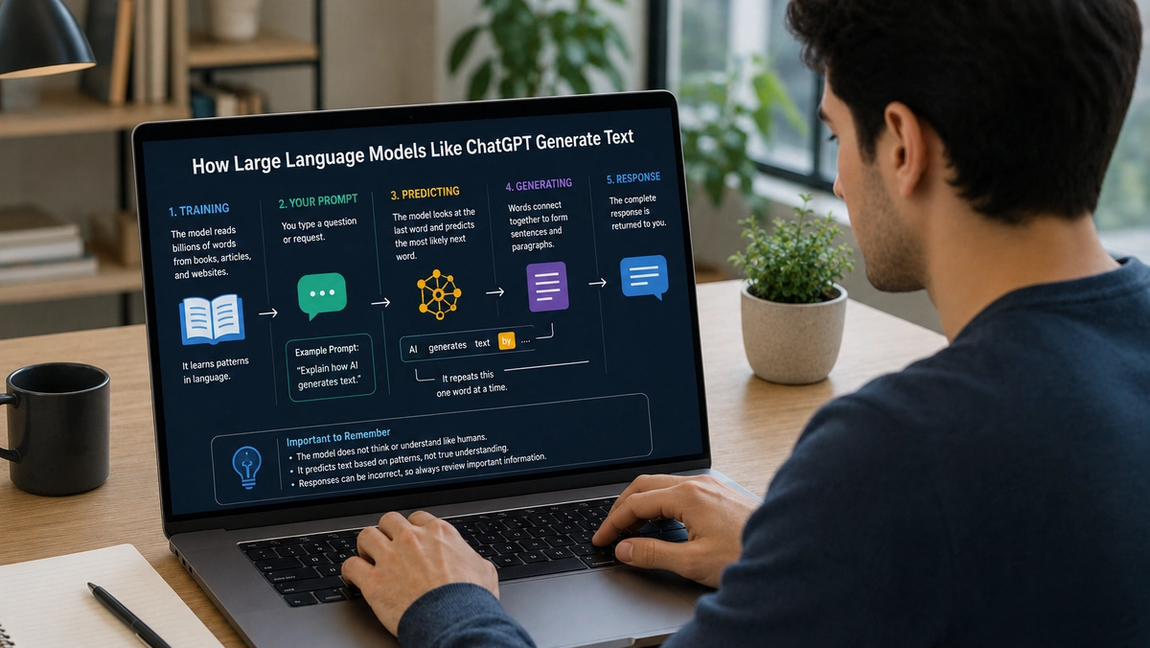
During training, the model analyzes enormous amounts of text, including books, articles, websites, and other written material. It isn’t taught grammar rules one by one, nor is it given a dictionary of ready-made answers.
Instead, it learns statistical relationships between words, phrases, sentences, and ideas. Over time, it becomes remarkably good at recognizing which words tend to appear together and how different concepts are connected.
For example, after seeing countless examples of language, the model learns that the phrase “peanut butter and…” is often followed by “jelly,” or that questions beginning with “How do I…” are typically followed by instructions.
Rather than memorizing every sentence it has encountered, the model learns general patterns that allow it to respond to entirely new prompts.
Generating text one word at a time
When someone types a question into an AI chatbot, the model doesn’t search a hidden database for a matching response.
Instead, it predicts what piece of text is most likely to come next based on the conversation so far and everything it learned during training.
Imagine writing a sentence where, after every word, you pause and ask, “What word would most naturally come next?” A large language model performs this prediction repeatedly at incredible speed.
Each new word influences the next prediction, allowing the response to develop naturally sentence by sentence until the answer is complete.
This process is similar to predictive text on a smartphone, but on a vastly larger scale. Rather than using a small personal vocabulary, modern language models have learned patterns across an enormous range of topics and writing styles.
Because the model continually considers the context of the conversation, it can maintain coherent explanations, answer follow-up questions, and adapt its writing style to different audiences.
Why responses aren’t always perfect
Although large language models are remarkably capable, they are not infallible.
Since they generate responses based on learned patterns rather than genuine understanding, they can sometimes produce incorrect or misleading information. They may confidently present inaccurate facts, misunderstand ambiguous questions, or generate responses that sound convincing but are not true.
The quality of the output also depends heavily on the prompt. Clear questions with sufficient context generally lead to more accurate and useful responses than vague or incomplete requests.
In many situations, language models also rely on the information available to them. If they lack access to recent developments or reliable data for a particular topic, their answers may be incomplete or outdated.
For this reason, AI-generated information should be reviewed carefully, especially when making important decisions involving health, finance, legal matters, or other high-stakes situations.
Large language models are tools for communication
The true strength of large language models lies in their ability to process and generate human language quickly and naturally.
They can summarize lengthy documents, brainstorm ideas, explain difficult concepts, assist with programming, draft business communications, translate languages, and support creative writing. Rather than replacing human expertise, they help people complete language-based tasks more efficiently.
As these models continue to improve, they are becoming valuable assistants across education, healthcare, business, research, and countless other fields. However, their effectiveness still depends on human judgment, thoughtful questions, and careful evaluation of the responses they generate.
Ultimately, large language models like ChatGPT do not produce text by thinking the way humans do. They generate language by predicting what should come next based on patterns learned from vast amounts of data and the context of the conversation. That ability to recognize and generate complex language patterns is what allows them to create responses that feel remarkably natural—even though the process behind them is fundamentally based on prediction rather than understanding.