How to Prompt AI Like a Pro
By Dalary Valdez on August 3, 2026
Why good prompts matter
Artificial intelligence has become an incredibly powerful tool for writing, research, brainstorming, coding, design, and problem-solving. Yet many people try AI once, receive an average response, and conclude that the technology isn’t very useful.
More often than not, the issue isn’t the AI—it’s the prompt.
A prompt is simply the instruction you give an AI system. Just as a vague question usually leads to a vague answer from a person, unclear prompts often produce generic or incomplete responses. The better your instructions, the better the results are likely to be.
Learning how to write effective prompts isn’t about using secret commands or complicated techniques. It’s about communicating clearly, providing context, and explaining exactly what you need.
Give the AI context before asking for an answer
One of the biggest mistakes people make is assuming the AI already knows what they’re trying to accomplish.
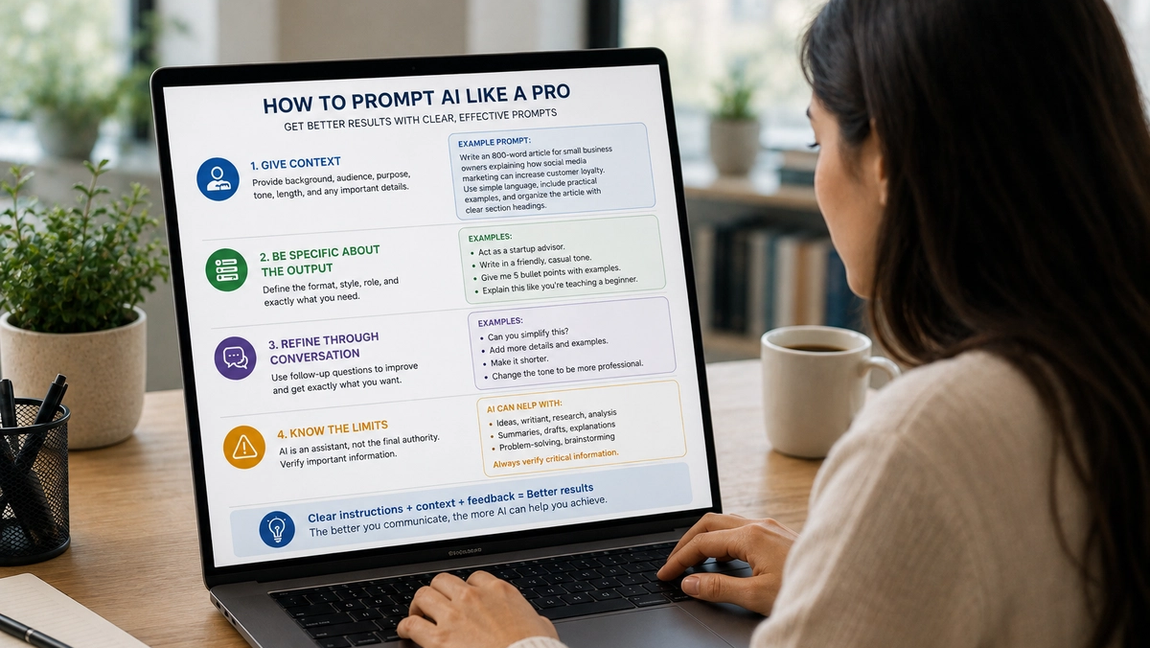
Instead of writing, “Write an article about marketing,” provide background information. Explain who the audience is, what tone you want, how long the article should be, and what objective it should achieve.
For example, a prompt like:
“Write an 800-word article for small business owners explaining how social media marketing can increase customer loyalty. Use simple language, include practical examples, and organize the article with clear section headings.”
is far more likely to produce useful results than a one-sentence request.
The more relevant context you provide, the more accurately the AI can tailor its response to your needs.
Be specific about the output
AI performs best when you clearly define what success looks like.
If you need an email, say so. If you want bullet points instead of paragraphs, specify that. Mention word count, formatting preferences, writing style, reading level, or any other important requirements.
You can also assign the AI a role.
For example:
- “Act as a startup advisor.”
- “Explain this like you’re teaching a beginner.”
- “Write as an experienced financial journalist.”
- “Review this contract as a business lawyer.”
Giving the AI a role helps shape both the perspective and the level of detail in its response.
The more precise your instructions, the fewer revisions you’ll need later.
Refine your prompts through conversation
One of AI’s greatest strengths is that it supports ongoing conversation.
You don’t need to create the perfect prompt immediately. Instead, treat the interaction as a collaboration.
If the first response is too technical, ask the AI to simplify it. If it’s too short, request additional detail. If you want examples, ask for them. If the tone feels too formal, ask for a friendlier version.
Each follow-up helps guide the AI toward the result you want.
This iterative approach is often far more effective than trying to write one extremely detailed prompt at the beginning.
Think of prompting as giving feedback to a colleague rather than issuing a single command.
Understand what AI can and cannot do
Even the best prompts cannot overcome the limitations of artificial intelligence.
AI can summarize information, generate ideas, explain concepts, draft content, analyze patterns, and help solve problems. However, it can also make mistakes, misunderstand ambiguous instructions, or confidently present inaccurate information.
For important decisions involving legal, financial, medical, or technical matters, AI should be treated as an assistant rather than the final authority. Verifying critical information remains essential.
It’s also worth remembering that AI isn’t a mind reader. It only knows what you tell it during the conversation and responds based on the information and context available.
Ultimately, prompting is a skill that improves with practice. Clear instructions, meaningful context, specific expectations, and thoughtful follow-up questions allow you to unlock far more of AI’s potential. The people who achieve the best results are rarely those using complicated prompts—they’re the ones who communicate their goals clearly. As AI becomes an increasingly common workplace tool, learning how to prompt effectively may become just as valuable as learning how to search the internet or use a spreadsheet.